Electric Counterbalance Forklift Truck
- Powerful Lifting Capacity – Handles heavy loads up to 5 tons with stable and balanced performance.
- Advanced Control System – Precise steering, smooth acceleration, and responsive braking ensure safe handling.
- Energy-Efficient Powertrain – Long-lasting lithium or lead-acid battery delivers extended runtime and low operating cost.
- Ergonomic Operator Cabin – Adjustable seat, intuitive controls, and wide visibility improve comfort and productivity.
- Versatile Application – Ideal for warehouses, factories, logistics hubs, and outdoor loading operations.
Recommend Electric Counterbalance Forklift for Sale
Experience powerful and efficient lifting performance with our Electric Counterbalance Forklifts for Sale, designed for versatile indoor and outdoor applications. Each counterbalance forklift truck combines strong load capacity, advanced control systems, and stable operation for safe and precise material handling. Whether you need a sit down counterbalance forklift for long shifts, a stand up model for quick maneuvering, or a 5 tonne counterbalance forklift for heavy-duty tasks, HUPER provides reliable solutions with excellent energy efficiency and ergonomic comfort. From warehouse storage to production lines, our electric counterbalance truck delivers superior performance, smooth handling, and excellent long-term value at a highly competitive counterbalance forklift price.

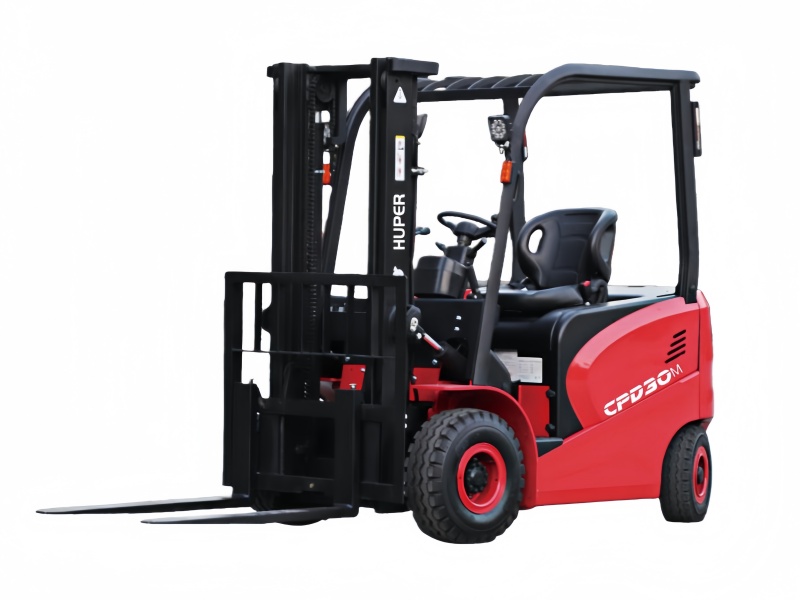


Your Premier Electric Counterbalance Forklift Manufacturer in China
- 20 years of professional forklift manufacturing experience.
- Large-scale production base covering 200,000㎡.
- Over 50 senior engineers and 800 skilled workers.
- Independent production of core components for stable supply.
- Complete quality control system with 100% full inspection.
- Strong OEM capability for global brands and partners.
- Advanced R&D team ensures continuous product innovation.
- Flexible production capacity meets large-volume orders.
- Competitive counterbalance forklift price with controlled costs.
- Reliable global export experience and dealer support.


Huper Electric Counterbalance Forklift Cases
- Warehouses with narrow aisles and heavy pallet stacking.
- Factories requiring stable indoor material handling.
- Logistics centers with high-volume cargo transfer.
- Airports for baggage and cargo movement.
- Railway stations handling bulk goods.
- Supermarkets and retail distribution centers.
- Cold storage and food industry environments.
- Outdoor yards with uneven ground conditions.
- Ports and docks for containerized goods transfer.
- Large-scale manufacturing plants with multi-shift operation.


Electric Counterbalance Forklift Manufacturer in China – HUPER Factory Direct Supply
The Electric Counterbalance Forklift is one of the most essential tools in modern material handling, providing efficiency, safety, and flexibility for industries worldwide. As a trusted manufacturer, HUPER has been dedicated to developing advanced counterbalance lift trucks for more than 20 years, serving both global distributors and large-scale end users. With a strong background in engineering and manufacturing, HUPER delivers solutions that combine innovation, durability, and cost-effectiveness.
A Counterbalance Forklift Truck is designed with a counterweight at the rear, balancing the load lifted at the front. This structure ensures maximum stability, making the truck reliable for handling heavy loads in diverse environments. HUPER’s electric counterbalance forklift for sale range includes models from 1,000 kg up to 8,000 kg, suitable for warehouses, factories, logistics hubs, ports, and outdoor yards. Our electric design eliminates emissions, reduces noise, and creates a clean working environment while maintaining powerful performance.
The product advantages of HUPER’s electric counterbalance truck series include strong structural durability, ergonomic operator cabins, and energy-saving drive systems. Operators benefit from smooth hydraulic lifting, advanced control systems, and intelligent safety features such as HUPER’s System of Active Stability (SAS). These innovations protect goods, operators, and trucks while ensuring high productivity across long shifts. In addition, modular energy solutions—including lead-acid and lithium-ion batteries—allow buyers to select the right power option for their operations, balancing cost efficiency and high performance.
Behind every HUPER counterbalance truck stands a world-class manufacturing base. Covering more than 200,000 square meters, our factory is among the largest forklift production sites in China. With over 50 senior engineers and more than 800 skilled workers, we combine experience with cutting-edge technology to deliver consistent quality. Importantly, HUPER manufactures many core components in-house, including batteries, chargers, gearboxes, chassis, and hydraulic systems. This vertical integration ensures stable supply, reduced costs, and reliable delivery timelines—advantages highly valued by B2B distributors and global partners.
Quality remains at the center of our operations. Every counterbalance lift truck undergoes strict inspections, including IQC, PQC, and QA processes. This 100% testing ensures that each forklift meets the highest performance and safety standards before shipment. With this comprehensive system, our customers receive products that align with international quality requirements and provide long-term reliability.
The application of HUPER’s counterbalance flt series extends across many industries. From smooth indoor warehouse aisles to rough outdoor environments, our forklifts are built to adapt. Whether in supermarkets, distribution centers, cold storage facilities, or heavy manufacturing sites, businesses can rely on our forklifts for precise load handling, efficient stacking, and safe transport. Multi-shift operations are supported through fast-charging lithium-ion batteries, enabling uninterrupted productivity.
As a global supplier, HUPER not only offers high-performance electric counterbalance equipment but also delivers competitive advantages for distributors. With strong OEM capabilities, large-scale production capacity, and attractive counterbalance forklift price levels, we help partners succeed in competitive markets. Our long-term export experience ensures smooth transactions, from order customization to after-sales support.
In conclusion, the HUPER Electric Counterbalance Forklift represents the perfect combination of innovation, reliability, and cost efficiency. With proven counterbalance lift truck technology, advanced safety systems, and a strong manufacturing foundation, HUPER continues to be the preferred partner for businesses seeking reliable electric counterbalance forklift solutions for sale. By choosing HUPER, buyers secure not only a forklift but also a long-term partnership with one of China’s leading counterbalance forklift manufacturers.
Electric Counterbalance Forklifts FAQs
What is a counterbalance forklift?
A counterbalance forklift is a ride-on industrial truck with forks at the front and a heavy counterweight at the rear. The counterweight offsets (i.e., “counterbalances”) the load so the truck can lift and carry pallets without outriggers. It’s the most common, general-purpose forklift for docks, yards, and warehouses.
What is electric counterbalance forklift?
It’s a counterbalance forklift powered by an electric traction/battery system instead of an internal-combustion (IC) engine. Modern electric models use AC drive/lift motors, electronic controllers, and either lead-acid or lithium-ion batteries. They excel indoors (zero tailpipe emissions, low noise), and—when specified with higher IP ratings and solid tires—handle light outdoor work on paved surfaces.
How to drive a counterbalance forklift?
-
Pre-shift checks: Tires, forks, mast chains/rollers, brakes, horn, lights, steering, hydraulics, battery/charge level, data plate.
-
Mounting & posture: Use three points of contact; adjust seat/steering; fasten seat belt.
-
Start & move: Key on; inching/brake depressed; select direction (F/R); release parking brake; accelerate smoothly.
-
Traveling: Forks low (100–150 mm / 4–6 in above floor), mast slightly tilted back, load upgrade when on ramps, obey speed limits, sound horn at intersections.
-
Stopping & parking: Neutral, parking brake, forks flat on floor, mast vertical, power off, remove key.
Always operate only after certified training per your local regulations (e.g., OSHA/WorkSafe).
How to operate counterbalance forklift?
-
Picking up a load: Approach square; stop; set mast vertical; align forks to pallet openings; insert fully; lift just clear; tilt back slightly; check for stability.
-
Transporting: Keep load low, tilt back, drive smoothly, avoid sharp turns (especially with mast elevated).
-
Stacking: Stop square to rack; level mast; raise to height; creep forward; place load; level; withdraw forks slowly; lower forks before travel.
-
Attachments: Use the correct rated capacity for clamps, sideshifters, rotators, etc.—attachments reduce the truck’s net capacity.
-
Visibility: If the load blocks view, travel in reverse with look-back mirrors/camera (or use a spotter).
What’s the difference between counterbalance and reach forklift?
-
Design: Counterbalance uses a rear counterweight; reach trucks use outriggers and extend (“reach”) the mast.
-
Aisles: Counterbalance ≈ 3.2–4.0 m (10.5–13 ft). Reach ≈ 2.4–2.7 m (8–9 ft).
-
Use case: Counterbalance = docks/yard + general handling. Reach = high-bay racking indoors, very tight aisles.
-
Stability outdoors: Counterbalance better on ramps/thresholds; reach trucks require smooth floors.
-
Lift height: Reach trucks commonly 9–12 m (30–40 ft) with very good capacity retention at height.
How does a counterbalance forklift work?
-
Levers & moments: The front axle is the fulcrum. Load moment (load × distance to axle) must be ≤ counter-moment (counterweight + truck weight × rear distance).
-
Stability triangle: Keep the combined center of gravity inside the triangle formed by the two front wheels and the center of the steer axle. Raising/tilting/turning shifts the center—drive accordingly.
-
Hydraulics & controls: Pump powers lift/tilt/auxiliary functions; electronic controllers modulate drive and lift for smooth, energy-efficient operation.
Electric counterbalance forklift for sale price
Typical new purchase ranges (indicative; vary by region/specs):
-
1.5–2.0 t (3,000–4,000 lb): USD $18k–$35k (lead-acid on the low end; lithium-ion higher).
-
2.5–3.5 t (5,000–7,000 lb): $25k–$55k.
-
4.0–5.0 t (8,000–11,000 lb): $45k–$75k+.
Options (mast height, cab, cameras, telematics) and battery chemistry strongly affect price. Quality used units often sell for $8k–$25k depending on hours and condition.
How to choose counterbalance forklift?
-
Load profile: Max weight, average weight, load center (commonly 500 mm/20 in), dimensions, and any attachments.
-
Lift height & racking: Highest pick + safety clearance + mast/overhead guard height limits.
-
Aisles & site: Minimum aisle width, turning space, floor condition, gradients, door thresholds.
-
Duty cycle & power: Shifts/day, hours/shift → choose lithium-ion for heavy multi-shift with opportunity charging; lead-acid for single-shift cost sensitivity; IC for heavy outdoor continuous use.
-
Environment: Temperature, dust/moisture (IP ratings), food/pharma hygiene (non-marking tires, stainless options).
-
Ergonomics & tech: Visibility, controls, seat, cameras, speed limiters, telematics.
-
Total cost of ownership (TCO): Energy, maintenance, tires, battery/charger, residual value, service coverage.
How to choose counterbalance forklift manufacturer?
-
Compliance & safety: Data plate accuracy; conformity to standards (e.g., ANSI/ITSDF B56.1, ISO 3691, EN/CE), battery UN38.3.
-
Components & build: Reputable controllers (ZAPI/Curtis/Danfoss), motors, hydraulics; welded chassis quality; IP protection.
-
Service network: Local parts stock, technician response, loaner programs, warranties.
-
References & tests: Site demo, operator feedback, telemetry trial, capacity verification at your load centers/heights.
-
Documentation: Clear manuals, parts catalogs, wiring/hydraulic schematics.
-
Financials: Lease vs buy options, battery warranties (cycles & years), uptime guarantees.
How to import Electric Counterbalance Forklifts from China?
-
Supplier vetting: Audit factories; verify certifications; request load charts, test reports, and references.
-
Specifications lock-in: Exact capacity @ load center, mast, tires, battery/charger, attachments, options, manuals language.
-
Compliance: Ensure conformity with your market’s rules (e.g., CE/UKCA where applicable, ANSI/ITSDF B56.1 + UL 583 in U.S.). Lithium battery UN38.3 and MSDS required for shipping.
-
Contracts & QC: Use a PO with Incoterms (FOB/CIF/DDP); book pre-shipment inspections; define acceptance tests.
-
Logistics & customs: Coordinate packing, HS heading 8427 (fork-lift trucks)—confirm exact subheading with your customs broker; arrange insurance and destination handling.
-
After-sales: Parts lists, training, warranty procedures, and local service arrangements.
What’s the difference between 3-wheel and 4-wheel electric counterbalance forklifts?
-
3-wheel: Tightest turning radius (single steer wheel), best in very narrow aisles and dock work; slightly lower lateral stability on uneven ground; typical capacity up to ~2.0 t.
-
4-wheel: Better stability, higher capacities (2.0–5.0 t+), stronger on ramps/yard work; turning radius wider than 3-wheel.
What load capacities are typical for electric counterbalance forklifts?
Commonly 1.0–5.0 t (2,200–11,000 lb). Specialty electric models go higher (6–12 t) with appropriate batteries and tires. Always check the data plate for rated capacity at your actual load center and mast height.
How do I choose the counterbalance forklift lift height?
-
Find your highest rack level (to the top of the load) + 100–200 mm (4–8 in) clearance.
-
Ensure the collapsed mast fits under doorways/mezzanines.
-
Taller masts reduce residual capacity—verify capacity at height with your heaviest load.
What aisle width do I need for a counterbalance forklift?
Use the Right-Angle Stack (RAS) method:
Aisle Width ≈ (Truck length to face of forks) + (Load length) + (Clearance 300–450 mm / 12–18 in).
-
Example: 1.95 m truck L2 + 1.2 m pallet + 0.35 m clearance ≈ 3.5 m (≈11.5 ft).
Most sites plan 3.2–4.0 m (10.5–13 ft) depending on truck size and safety margin.
Electric vs IC (gas/diesel) counterbalance forklift —which is better for me?
-
Electric: Zero tailpipe emissions, quiet, strong low-speed torque, lower maintenance, energy-efficient; needs charging infrastructure; best indoors and paved yards.
-
IC (LPG/diesel): Fast refuel, robust in harsh outdoor conditions, high continuous power; higher noise/emissions and maintenance; not ideal for food/pharma clean areas.
Rule of thumb: Mostly indoor or mixed light outdoor → Electric. Heavy outdoor, long continuous shifts without charging → IC (or very high-capacity electric if infrastructure allows).
Lead-acid vs lithium-ion counterbalance forklift —pros and cons?
| Battery | Pros | Cons | Best for |
|---|---|---|---|
| Lead-acid | Lowest upfront cost; widely available service | 8–10 h full charge + 8 h cool-down; watering; sulfation risk; ventilation needed; heavier | Single-shift, cost-sensitive operations |
| Lithium-ion (Li-ion) | 1–3 h fast charge; opportunity charging; high efficiency; no watering; long cycle life; works well in cold storage (with heaters) | Higher upfront cost; needs BMS-compatible charger; shipping/compliance steps | Multi-shift, high uptime, energy-sensitive sites |
How to maintain electric counterbalance forklift?
-
Daily: Visual checks, tires, forks, chains, hydraulic leaks, brakes/steering, lights/horn; clean debris; verify battery SOC and alarms.
-
Weekly: Check chain tension/elongation, mast rollers, hydraulic oil level, brake fluid, steering linkages; clean battery and connectors.
-
Monthly/Quarterly: Inspect electrical cables, contactors, drive/lift motors, cooling fans/filters; torque critical fasteners; calibrate safety interlocks; update telematics/firmware.
-
Battery care: Keep connectors tight/clean; follow charging windows; equalize charge (lead-acid); monitor BMS logs (Li-ion).
-
Records: Maintain service logs and pre-shift inspection checklists.
How to repair electric counterbalance truck?
-
Safety first: Power down, chock wheels, disconnect battery, follow lock-out/tag-out (LOTO).
-
Diagnostics: Retrieve fault codes via display/telematics; check fuses/contactors/relays; inspect wiring looms for abrasion; verify sensor harnesses (lift, tilt, seat, pedal).
-
Common fixes:
-
No drive/lift: Battery undervoltage, main contactor, seat switch, brake switch.
-
Rough lifting: Low hydraulic oil, clogged return filter, worn pump.
-
Error under load: Thermal derate; check cooling path and motor temp sensors.
-
-
When to call a tech: Structural issues (mast/carriage/rails), welds, chain replacements, controller re-programming, high-voltage battery service.
How long does the electric counterbalance truck battery last?
-
Per charge runtime: Typically 6–8 hours of mixed duty for lead-acid; 6–10+ hours for Li-ion with opportunity charging.
-
Service life: Lead-acid ~1,200–1,500 cycles (3–5 years) with proper care; Li-ion ~2,500–4,000+ cycles (6–10 years) depending on chemistry, depth of discharge, and environment.
How long to charge the electric counterbalance forklift truck?
-
Lead-acid: 8–10 hours standard charge + recommended cool-down; fast-charge systems exist but impact life if overused.
-
Lithium-ion: Typically 1–3 hours from low state of charge with the correct high-frequency charger; partial opportunity charging (e.g., during breaks) is encouraged and does not harm the pack when managed by the BMS.
 EN
 ES
 AR
 RU
 FR
 PT
 DE
 IT